
categories
All Categories
- Bitcoin
- Centralised Exchanges
- Crypto
- Crypto Asset Volatility
- Crypto Correlations
- Crypto Governance
- Crypto in the Portfolio
- Crypto Valuations
- DeFi
- ESG
- Ethereum
- Investment Highlight
- Regulation
- Security and Privacy
- Social Media Influence
- Stable Coins
- Traditional Finance and Crypto
- Uncategorized
- UNSDG
- Web 3.0
Authors
All Authors
Out of the Grey Zone
by Quinn Papworth
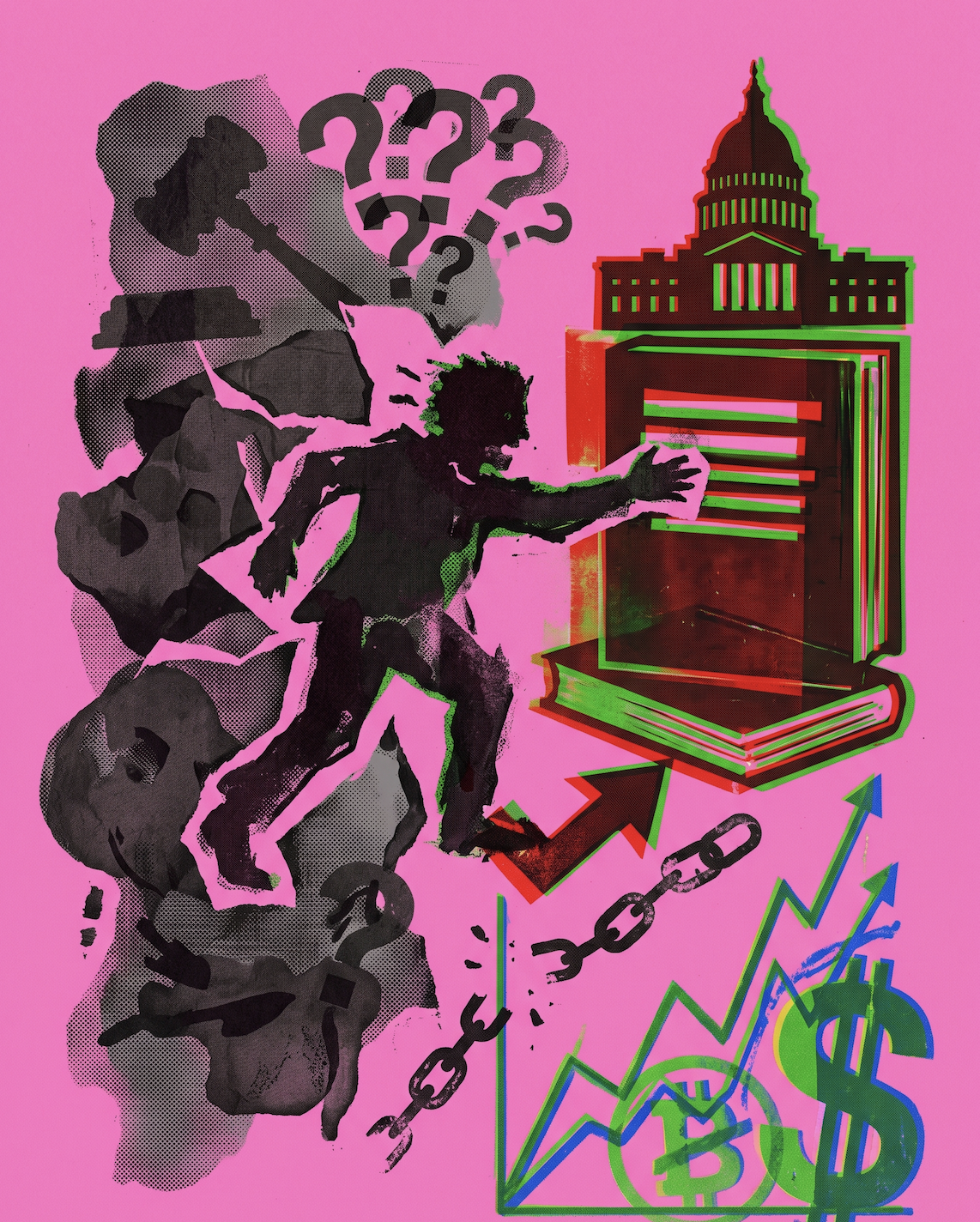
For the better part of a decade America’s $2.7trn crypto market has lived in a regulatory twilight. The Securities and Exchange Commission (SEC) treated most tokens as unregistered securities; the Commodity Futures Trading Commission (CFTC) claimed jurisdiction over the spot markets in bitcoin and ether. Neither agency wrote rules so much as filed lawsuits. Builders fled to Singapore and Dubai; institutions sat on their hands; investors were left to read tea leaves of enforcement actions. That arrangement may, at long last, be coming to an end.
On May 2nd Senators Thom Tillis, a North Carolina Republican, and Angela Alsobrooks, a Maryland Democrat, released compromise text on the most contested provision of the Digital Asset Market Clarity Act, better known as the CLARITY Act. The bill—which passed the House of Representatives in July 2025 by a comfortable bipartisan margin of 294 to 134—would do for digital assets what Dodd-Frank did for derivatives: replace a thicket of competing claims with a federal statute. After four months of stalling in the Senate Banking Committee, a markup is now penciled in for the week of May 11th. Markets noticed. Bitcoin briefly cleared $80,000 for the first time since January; shares in Circle, the issuer of the USDC stablecoin, jumped almost 20%; Coinbase rose 6%. Brian Armstrong, Coinbase’s chief executive, summed up the industry’s mood in three words on social media: “Mark it up.”
What the bill actually does
The CLARITY Act’s ambition is to draw a line, finally, between the SEC and the CFTC. Tokens whose value derives chiefly from a “functioning blockchain network”—broadly, public, sufficiently decentralised systems—would be classed as digital commodities and policed by the CFTC. Tokens still being marketed to fund a project’s development would remain securities under the SEC’s gaze, with a new tailored capital-raising exemption. Crucially, the bill creates a “mature blockchain” certification, a checklist of decentralisation criteria (no controlling entity, open-source code, distributed ownership, a working network) that lets a token graduate from one regime to the other. Bitcoin and ether, which the two agencies jointly identified as commodities in a March 17th taxonomy of 16 such assets, would qualify on day one.
That alone would be consequential. The bill goes further. It carves out explicit safe harbours for non-custodial software—wallet developers, validators, oracles, automated market-makers—so that writing code is not, in itself, a federally regulated activity. It imposes registration, capital and customer-segregation rules on exchanges, brokers and dealers, with a 90-day provisional regime to avoid stranding firms during rule-making. It folds in the GENIUS Act, the stablecoin law enacted in 2025, and bolts on an “anti-CBDC” provision barring the Federal Reserve from issuing a digital dollar to retail users—a sop to libertarian Republicans, and the price of their votes.
The cost of the status quo is not theoretical. On October 10th-11th 2025, as the bill languished in the Senate, bitcoin tumbled from a peak of $125,000 to as low as $60,000, wiping out some $19bn in leveraged positions in a single session—roughly ten times the carnage of the FTX implosion. Circle’s shares, which once traded above $300, sat at $62.50 in February. The point is not that legislation moves prices (though it plainly does). The point is that an unwritten rulebook leaves an entire asset class hostage to enforcement headlines and offshore plumbing.
The yield knot
The bill’s path through the Senate has been blocked, almost entirely, by a single question: may a crypto firm pay its customers for parking stablecoins in an account? Banks, who have built their franchises on the spread between cheap deposits and expensive loans, said no. Crypto firms, who have built theirs on Coinbase’s roughly $1.3bn in stablecoin reward revenue last year, said yes.
Mr Tillis and Ms Alsobrooks have split the difference. Their text bars rewards that are “economically or functionally equivalent” to bank-deposit interest, but permits “bona fide” incentives tied to genuine activity—trading, transferring, paying, lending or staking. In short, firms must shift from a “buy and hold” model to a “buy and use” one. The banking lobby gets to keep its moat around passive deposit interest. The crypto industry gets to keep paying users who actually do something. Bank of America’s analysts pronounced the deal a “net positive” for both sectors, which is the closest thing to bipartisan endorsement Washington manufactures.
The compromise is also a quiet victory for a particular flavour of decentralised finance. Yield-bearing stablecoins such as Sky’s sUSDS and Maple’s syrupUSDC derive returns not from solely sitting on Treasury bills but from on-chain lending spreads and protocol revenues. Their architecture maps onto the “activity-based” carve-out, and they sit behind the bill’s safe-harbour wall for non-custodial code. Capital that can no longer be courted with passive yield by centralised platforms has somewhere obvious to go.That being said products such as sUSDS and syrupUSDC have increasingly relied on RWAs as yield sources in recent months, so the final verdict on this front is yet to be seen.
The remaining hurdles
The yield deal is the largest log on the river, but not the last. Senator Tim Scott, the Banking Committee’s chairman, told Fox Business his side is “in the red zone” but admitted he has yet to corral all 13 Republican votes—Senator John Kennedy of Louisiana remains a holdout. Mr Tillis has flagged a fresh objection from law enforcement groups, who argue that the DeFi safe harbour shields developers whose protocols are used by criminals. Senate Democrats want an ethics provision barring federal officials from holding personal stakes in crypto businesses—language aimed, transparently, at the Trump family, whose various token ventures have raised eyebrows even on the right. None is a deal-breaker on its own. Together, they consume the kind of floor time the Senate does not have.
The calendar is the real adversary. Eight working days separate the targeted markup from the Memorial Day recess on May 21st. After that, a 60-vote Senate floor vote (Mr Scott is aiming for June or July), reconciliation with the House version and the Agriculture Committee’s companion bill, a conference report, and a presidential signature must all be jammed in before midterm campaigns make any vote touching DeFi or stablecoins toxic. Senator Cynthia Lummis, the Wyoming Republican who has been one of the bill’s most dogged shepherds, warned at the Bitcoin 2026 conference that the alignment behind it is “rare and fragile”. Polymarket users seem to agree: their odds of passage in 2026 have slipped from 65% in January to 46% today, even with the latest news.
Winners, losers and the limits of clarity
Should the bill survive its remaining gauntlet, the consequences will be uneven. Bitcoin and ether emerge as the closest thing crypto has to investment-grade, with the regulatory premium that has kept pension funds and corporate treasuries on the sidelines compressed at a stroke. Truly decentralised projects gain a path to commodity status; founder-controlled tokens that resemble equities will be treated as such, indefinitely. DeFi protocols, custodians and exchanges domiciled in America acquire something they have lacked since their inception: a licence to exist.
Centralised platforms whose business depended on advertising bank-like yields on idle stablecoin balances will have to retool. Offshore venues lose their regulatory-arbitrage premium. Traditional banks gain a temporary moat against deposit flight, though they will eventually compete with compliant crypto rails for payments and settlement; the Depository Trust and Clearing Corporation’s tokenised-securities pilot, due in July, is a foretaste.
The bill is not elegant. It is the product of horse-trading among bank lobbyists, crypto chief executives, two warring federal agencies and a White House that has mostly cheered from the sidelines. It will spawn 270 days of rule-making by the SEC and CFTC, plenty of litigation, and, almost certainly, loopholes that will require amendment. Many of the protections it creates—segregated customer assets, bankruptcy priority, mandatory disclosures—are so basic that their absence has been the actual scandal.
But the alternative is the status quo, and the status quo has a price. America has spent a decade running an enforcement regime that punished bad actors after the fact and chased good ones offshore. The CLARITY Act, for all its compromises, would replace that with rules.

Quinn Papworth
Quinn holds a Bachelor of Business from RMIT, majoring in Finance & Blockchain Enabled Business and has 4 years experience actively investing in crypto markets. Quinn is an analyst at Apollo Crypto and is deeply passionate about producing accessible crypto research content to help educate and onboard users.