
categories
All Categories
- Bitcoin
- Centralised Exchanges
- Crypto
- Crypto Asset Volatility
- Crypto Correlations
- Crypto Governance
- Crypto in the Portfolio
- Crypto Valuations
- DeFi
- ESG
- Ethereum
- Investment Highlight
- Regulation
- Security and Privacy
- Social Media Influence
- Stable Coins
- Traditional Finance and Crypto
- Uncategorized
- UNSDG
- Web 3.0
Authors
All Authors
A Tale of Two Cities
by Quinn Papworth
This blog covers:
- The signal. CME leveraged funds have flipped net long on bitcoin futures for the first time in years, breaking a structural short position that has held since the basis trade became crowded.
- The mechanism. The carry trade now pays less than a two-year Treasury, so the professional dollar has to pick a direction. It picked up.
- Why it matters. More than 100 crypto projects have folded in 2026 while tokenised real-world assets have grown to $38bn. Both numbers describe the same sorting process, and the positioning shift is a bet on which side of it wins.
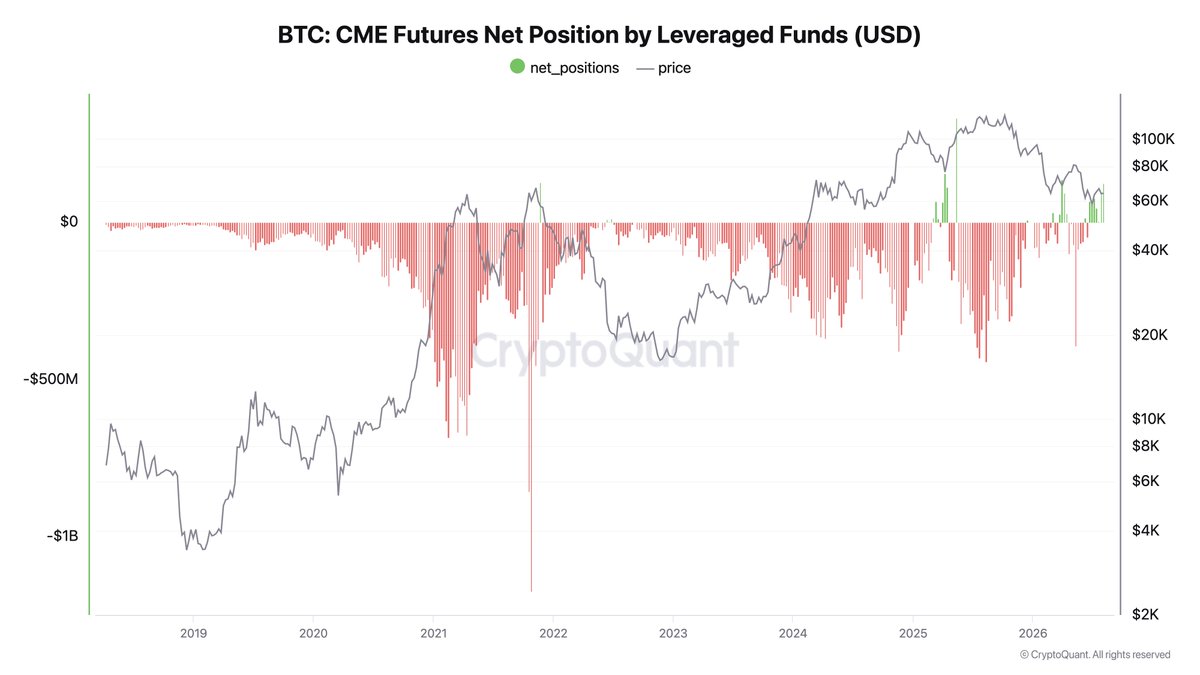
On August 10th Ki Young Ju, the chief executive of CryptoQuant, an analytics firm, posted a chart that had spent the better part of three years in the red. It had turned green. Leveraged funds trading bitcoin futures on the Chicago Mercantile Exchange (CME), the “hedge funds” line of the Commitments of Traders report, had flipped net long. “The suits are now betting on bitcoin’s upside,” Mr Ju wrote.
The suits chose an odd week for it. Bitcoin, at roughly $65,000, has clawed back from a low near $58,000 on July 1st, but it remains down more than 30% for the year and some 50% below its October 2025 peak. The wider market, at about $2.3trn, is roughly 52% below the same high-water mark. And in the fortnight before the suits turned bullish, four notable firms announced closures or bankruptcy filings in a single week, an eleven-year-old exchange that invented the perpetual swap began winding itself up, and an entire Polkadot parachain stopped producing blocks.
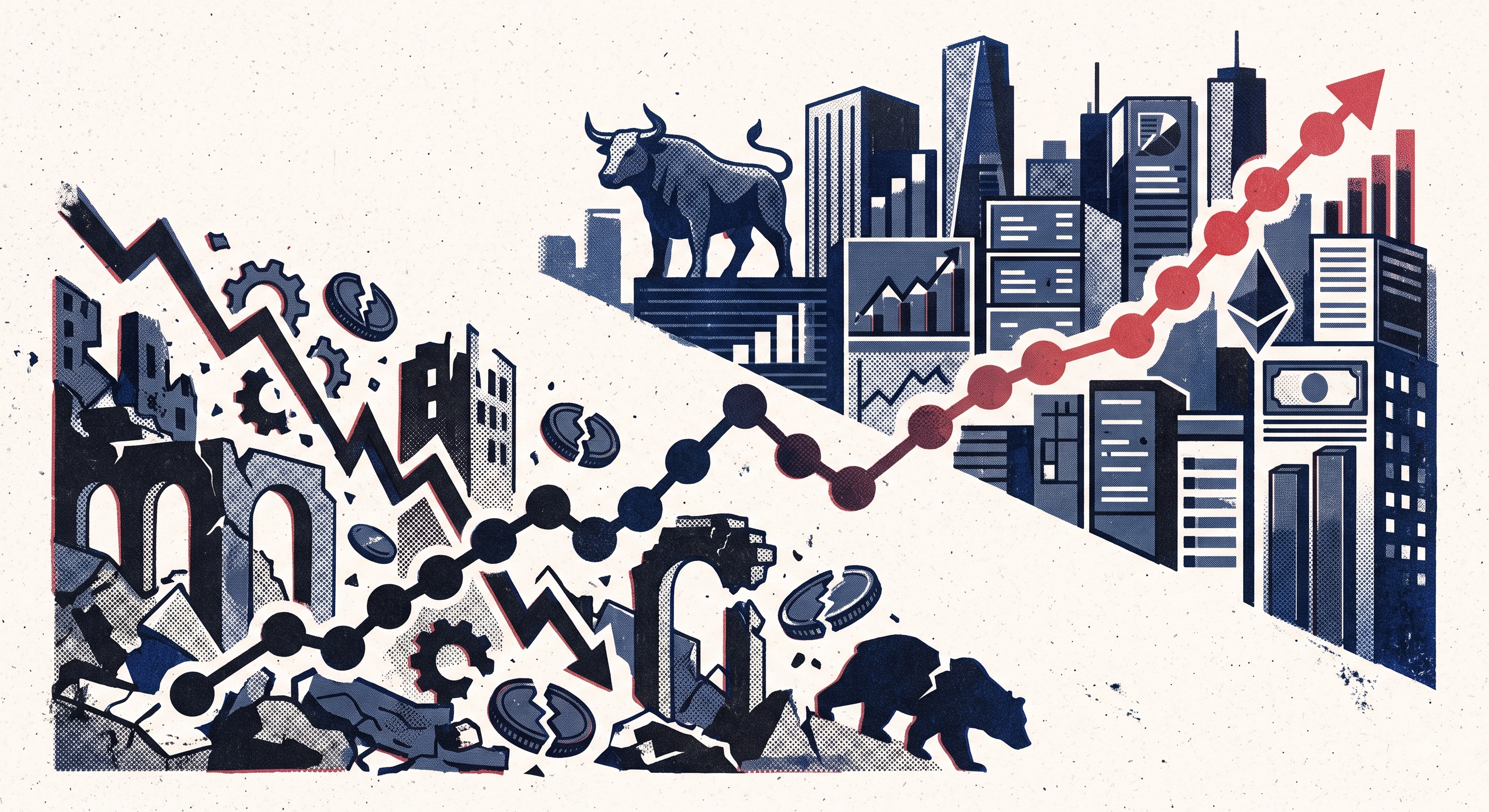
Read together, the two developments describe a market that has split into two cities. In the first, capital is being destroyed at the fastest pace since the last cycle’s blow-up. In the second, the largest asset manager in the world is minting money-market fund shares on Ethereum. The hedge funds are positioning for the second city.
Chicago goes long
To grasp why the CME chart matters, it helps to understand why it was red for so long. The trade that kept it there is the cash-and-carry, or basis, trade: buy spot bitcoin (or, more conveniently, a spot exchange-traded fund), sell the CME future against it, and collect the premium as the two converge. The position is market-neutral. It expresses no view on bitcoin’s price. It does, however, require a short futures leg, which is why an entire cohort of professional traders showed up in the data as structurally bearish while being nothing of the kind.
That is the arithmetic that makes the flip interesting. A book cannot be net long in aggregate and still be running a classic carry trade. Crossing the line therefore implies one of two things: that the carry traders have unwound, or that someone is making a directional bet. Probably both.
The proximate cause is unglamorous. The annualised three-month bitcoin futures basis has compressed to roughly 3%, below the roughly 3.8% available on two-year American Treasuries. Once financing, margin and execution costs are deducted, a trade that requires custody, two venues and a rolling futures leg is being paid less than a government bond that requires none of those things. Capital has done the sensible thing and left.
What replaced it is the part worth arguing about. Spot bitcoin ETFs took in $853.5m in the five sessions to August 7th, their strongest week since April 17th, of which BlackRock’s IBIT accounted for $693.5m. That ended an eight-week run of outflows. Cumulative net inflows since the funds launched in January 2024 now exceed $52bn.
The caveats are equally arithmetic. The first half of 2026 saw $5.4bn of net outflows from those same funds, the first negative half-year in their history. Total net assets sit near $80bn, roughly half their peak. The Coinbase premium, a rough proxy for American spot demand, spent a record 48-day stretch in negative territory earlier this summer, and open interest has repeatedly failed to confirm July’s rallies, suggesting that some of the strength was short-covering rather than conviction. Bitcoin has yet to close decisively above its 50-month exponential moving average at $65,827, a level momentum traders are watching closely. July’s consumer and producer-price prints, due on August 12th and 13th, will do more to settle the next fortnight than any positioning chart
The worst of times
RootData, which tracks Web3 projects, counts more than 100 that have shut down, filed for bankruptcy or gone permanently dark in 2026. More than half were DeFi protocols; the rest span exchanges, wallets, layer-2 networks, NFT platforms, analytics tools and games.
The late-July week was the emblematic one. BitMEX, which invented the 100x perpetual swap and ran eleven years without losing customer funds to a hack, announced on July 23rd that it would close on September 23rd following a strategic review. BitMart said on July 27th it would wind down after nine years. Movement Labs and Storj Labs filed or folded in the same seven days. Moonbeam, a Polkadot parachain, stopped producing blocks on July 31st, stranding assets belonging to users who had not bridged out in time. Earlier casualties include Loopring, Balancer Labs, Goldfinch, NFTfi, Zapper and Tally, the governance platform that ran voting for more than 500 DAOs.
| Cause | Mechanism |
| Token-denominated treasuries | Altcoin drawdowns of 70% to 90% wiped out the balance sheets of firms that had raised in their own tokens |
| Funding drought | Venture investors have grown selective; rescue rounds have largely stopped |
| Security costs | Blockaid counted 212 on-chain exploits stealing about $1.1bn in the first half of 2026, a record, and more than one a day. Two April incidents alone cost roughly $293m and $285m |
| No durable revenue | Survivors charge real fees in cash or stablecoins; the rest were subsidising usage with emissions |
A caution on the headline number, since it will be quoted loosely elsewhere. RootData’s list treats a bankruptcy filing and an orderly community-voted sunset as the same data point. Tally concluding that its funding model no longer worked is not the same event as an exchange collapsing into insolvency. Some entries are pivots or single-product retirements. The figure is a good measure of attrition and a poor measure of catastrophe.
It is also not a fraud story. There is no Terra here, no FTX. This is the quieter kind of failure: projects that raised heavily, shipped competently and never found anyone willing to pay. Nick Puckrin of Coin Bureau put the industry’s own gloss on it: “Creative destruction for the next cycle perhaps.” He added that for every closure announced, perhaps ten happen silently.
Consolidation of this kind is what the end of an infrastructure glut looks like. The layer-2 boom of 2023 made it trivially cheap for anyone to launch a chain, and a great many people did. What is being culled now is the surplus, not the technology.
A carry trade paying less than a two-year note tells you the easy, structural arbitrage in this market has been competed away. That is what maturity does to free money.
The best of times
Two blocks over, the other city is under construction.
Tokenised real-world assets (RWAs) reached $38.17bn in on-chain value on August 9th, according to rwa.xyz, within touching distance of $40bn. Tokenised American government debt is the largest slice at $16.21bn, spread across 87 distinct products and held by 63,010 addresses. The number of RWA holders overall rose by 56% in a month, to about 1.7m.
The league table has quietly reshuffled. Circle’s USYC now leads Treasury-backed tokens at $3.00bn, ahead of BlackRock’s BUIDL at $2.68bn, Ondo’s OUSG at $2.14bn and Franklin Templeton’s iBENJI at $1.72bn. BUIDL is no longer the automatic name to cite.
More telling than the stock is the flow. A report published on August 6th by CoinShares with Token Terminal, covering the year to the second quarter of 2026, found that RWA deposits into lending platforms and decentralised exchanges more than tripled, from $2.3bn to $7.4bn, while total DeFi deposits fell by about 15%. Aggregate spot DEX volumes dropped roughly 70% over the same window. RWA spot volumes rose about 220%, admittedly from a small base and concentrated in tokenised gold. RWA positions now account for more than a quarter of on-chain perpetuals open interest, in a perps market that has been shrinking since October 2025. Nearly 70% of that collateral sits on Ethereum, with Plasma and Solana behind it.
Growing while the host market contracts is the whole point. Jean-Marie Mognetti, CoinShares’ chief executive, argues that the divergence shows “tokenisation is structural, not cyclical”. Demand of that shape is coming from utility rather than from price.
The institutional plumbing is arriving to match. On August 4th BlackRock launched 12 tokenised share classes across six of its Institutional Cash Series money-market funds, minted on Ethereum via Kinexys, JPMorgan’s tokenisation platform, and available in 15 markets under the UCITS framework.
Perspective is still owed. Roughly $2.2bn of a global equity market worth over $100trn has been tokenised. On CoinShares’ own comparison, the asset class sits about where stablecoins sat in 2019.
Two cities
The connection between the two halves is not decorative. Consider what the professional bid is actually being offered in 2026.
On one side, an asset class shedding the projects that never generated revenue, with the survivors (Aave, Hyperliquid, Ether.fi and their peers) distinguished chiefly by charging real fees. On the other, a growing inventory of on-chain instruments that yield, that clear, and that compliance departments already understand, because they are Treasury bills and money-market fund shares wearing a new wrapper. Bitcoin remains the liquid, regulated, ETF-wrapped expression of the whole complex. It is the same dispersion we wrote about when HYPE broke ranks with bitcoin, now visible at the level of the industry rather than the individual token.
A carry trade paying less than a two-year note is a signal that the easy, structural arbitrage in this market has been competed away. That is what a maturing market does to free money. Funds that keep the exposure and drop the hedge are making a statement about which of the two cities they expect to be living in.
The bearish reading is available and should be stated plainly. Spot demand signals remain mixed. Bitcoin is still in a drawdown that began ten months ago. RWA growth, impressive in percentage terms, is concentrated in one asset class on one chain, and much of it is a wrapper around a yield that the Federal Reserve is providing rather than the blockchain.
The Apollo Crypto View
The CME flip is worth noting, and not worth over-reading. We would treat it as confirmation of something already visible in the plumbing rather than as a leading indicator. The arbitrage has compressed, the marginal professional dollar has to choose a direction, and enough of it chose upside, to push a chart into positive territory.
The more durable observation is compositional. Crypto is not shrinking so much as sorting. Assets and businesses with cash flows, collateral value or regulatory standing are absorbing capital; those that had only a token and a narrative are being wound down, in most cases quietly and without drama. Roughly a hundred obituaries and $38bn of tokenised assets are the same statistic viewed from opposite ends, decay and growth.
The parallel we keep returning to is the dot-com crash, where the failure rate was never the story. What mattered was that the surviving names came out of it owning the infrastructure everyone else had spent the boom building. We would rather underwrite revenue and collateral quality than narrative breadth, and we treat “institutional adoption” as a claim to be checked product by product.

Quinn Papworth
Quinn holds a Bachelor of Business from RMIT, majoring in Finance & Blockchain Enabled Business and has 4 years experience actively investing in crypto markets. Quinn is an analyst at Apollo Crypto and is deeply passionate about producing accessible crypto research content to help educate and onboard users.