
categories
All Categories
- Bitcoin
- Centralised Exchanges
- Crypto
- Crypto Asset Volatility
- Crypto Correlations
- Crypto Governance
- Crypto in the Portfolio
- Crypto Valuations
- DeFi
- ESG
- Ethereum
- Investment Highlight
- Regulation
- Security and Privacy
- Social Media Influence
- Stable Coins
- Traditional Finance and Crypto
- Uncategorized
- UNSDG
- Web 3.0
Authors
All Authors
Clarity Failed, The Agencies Didn’t
by Quinn Papworth
Clarity failed. The agencies didn’t.
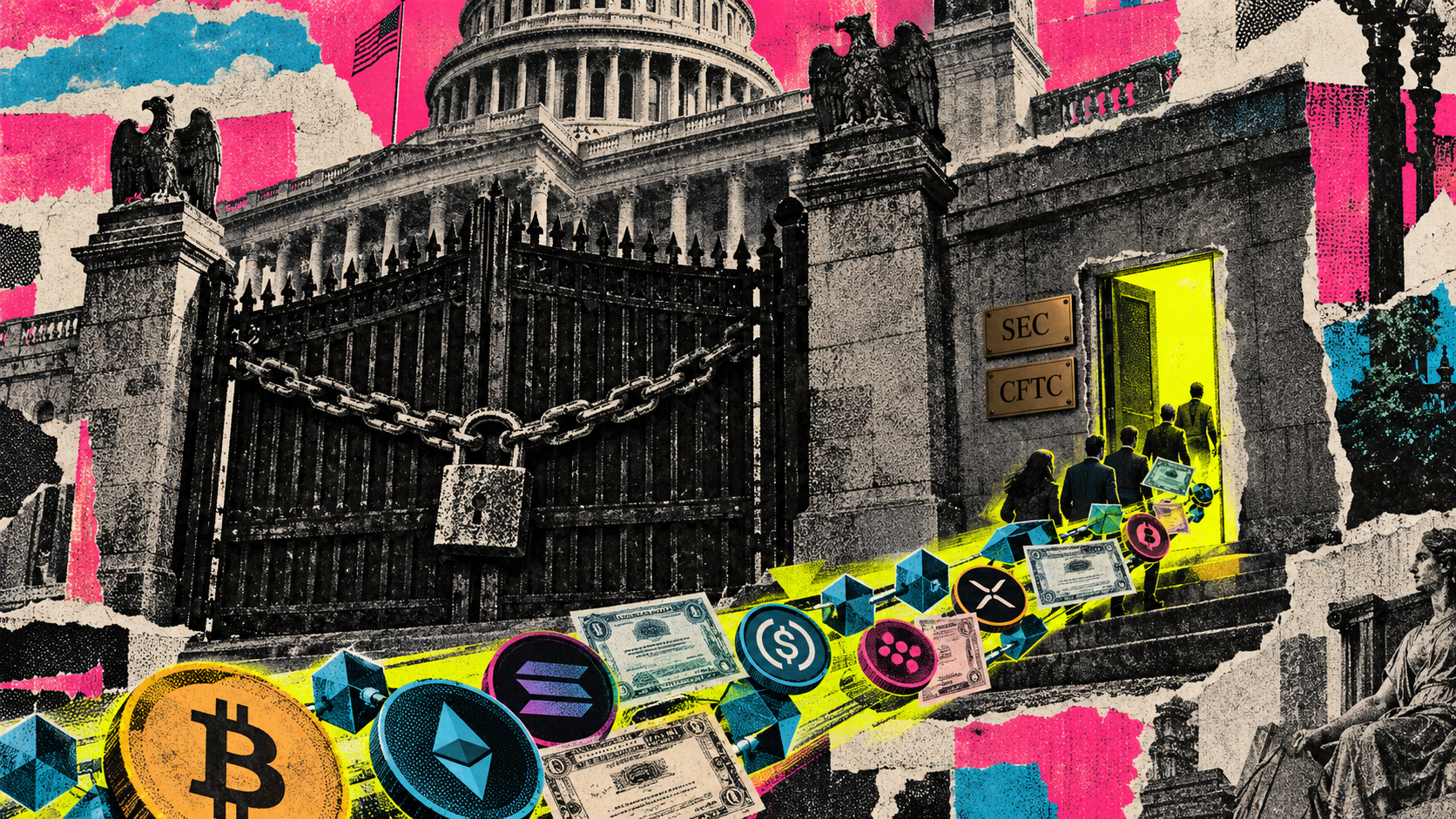
The Senate kept the gate shut on crypto market-structure law. Within 48 hours, the regulators had opened a side door
Last week we argued that the vote on H.R. 3633 was a gate, not a destination. Cloture on the motion to proceed would only have let the Senate begin debating the Digital Asset Market Clarity Act; final passage was a separate fight. On September 15th the gate stayed shut. The motion failed 49-50, eleven votes short of the 60 required. Every Democrat and independent who voted said no. So did four Republicans: Susan Collins, Josh Hawley, Jerry Moran and Thom Tillis. Mr Tillis’s defection was tactical. He switched from yes to no so that, as a member of the prevailing side, he could move to reconsider. Chris Coons did not vote.
The bill did not die for want of negotiation. It died of the same three disputes that shaped its final draft. The first was ethics. The Trump family’s crypto ventures, World Liberty Financial chief among them, left Democrats unwilling to hand a new supervisory regime to an administration whose enforcement credibility they doubt. The second was stablecoin yield, where banks lobbied hard against any rewards on stablecoin balances, fearing a slow leak of deposits. The third was a residue of quarrels over developer protections, DeFi and the Agriculture Committee’s language. Democrats who had spent months at the table concluded that the text still fell short.
Formally, the bill lives. The motion to reconsider stands and H.R. 3633 remains on the calendar. Practically however, the 2026 window has closed. The House has cancelled sitting weeks, the Senate departs for its October state work period, and the midterms fall on November 3rd. Polymarket’s odds of enactment this year collapsed into single digits.
The side door
Two days after the vote, on September 17th, the Securities and Exchange Commission issued its long-trailed “Innovation Exemption”. Paul Atkins, its chairman, framed it explicitly as a response to Congress’s failure. The relief is real, but it is narrower than the headlines suggest, and precision matters here.
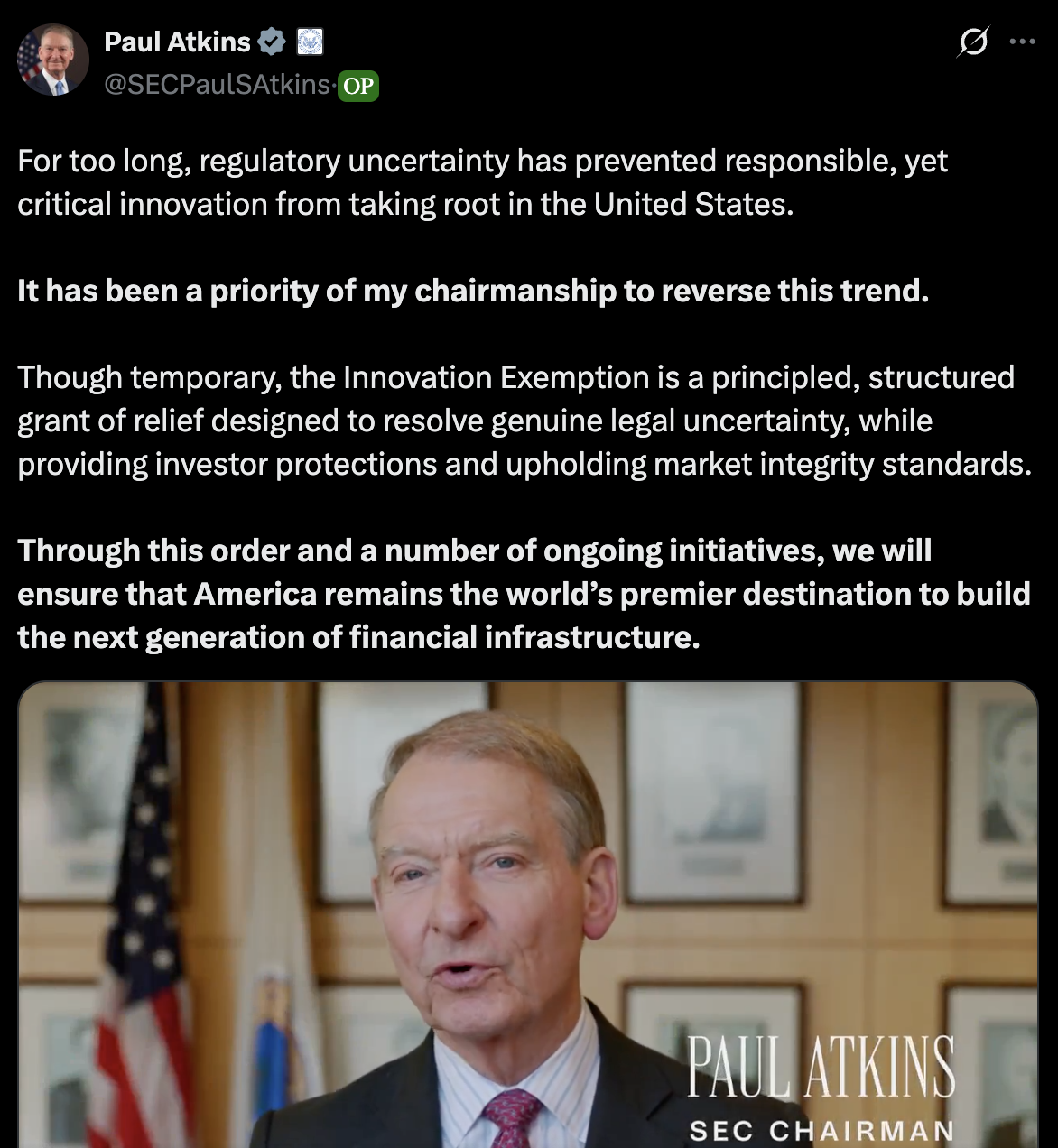
The order grants five years of temporary, conditional relief, expiring on September 17th 2031. It creates a new category, the Tokenised Securities Venue (TSV), which may trade tokenised versions of listed American stocks through permissioned automated market makers and liquidity pools without being treated as an “exchange”. Certain liquidity providers, dubbed “Covered Firms”, are spared registration as dealers. The conditions are tight. Tokenised shares must carry the same economic and voting rights as the underlying. Where a third party tokenises a company’s shares, the issuer must be notified and given the chance to object. Participants must be American, sanctions screening applies, and trading must halt whenever the primary exchange halts. Volumes and eligible symbols are capped, and venues face transparency and record-keeping duties. There are no synthetics and no leverage. The SEC calls it a pilot: a data-gathering bridge towards rulemaking, not a permanent framework.
The Commodity Futures Trading Commission moved the same day. Staff Letter 26-25 broadens no-action relief for “passive software” providers, meaning wallets, front-ends and routing tools, so that they are not treated as introducing brokers merely for connecting users to registered futures commission merchants, introducing brokers or designated contract markets. The approach was first tested in a letter to Phantom, a wallet provider. It is now available to any provider that meets the conditions: no custody, no discretion, adequate disclosure and the rest.
The pairing is the point. The SEC acted on tokenised securities; the CFTC acted on the software layer that touches derivatives. Between them, the two agencies now occupy a meaningful slice of the ground that Clarity was meant to settle by statute.
The industry is renting regulatory space rather than owning it.
The shrug
Markets noticed the vote, briefly. Bitcoin fell by roughly 3%, towards $76,000; ether, solana and alts fell further. Shares in Coinbase and Circle dropped by 8-11%, and leveraged longs were liquidated. Then the exemption landed and the mood turned. Bitcoin reclaimed the $80,000 area within days, and DeFi tokens with exposure to automated market makers, Uniswap’s UNI among them, outperformed.
The muted reaction is easily explained. The legislative failure was largely priced in; enactment odds had been sliding for weeks. The agency relief, by contrast, was concrete and immediate. Traders treated Clarity’s collapse as disappointing rather than structural, and interest rates and the broader macro tape continue to matter more to crypto prices than Senate procedure. Last week we predicted that, if statute failed, the industry would fall back on agency relief. That is what happened. It merely happened faster than expected.
Where to from here
The legislative road is narrow. A lame-duck session after November 3rd offers a sliver of hope, but most observers, including Senator Cynthia Lummis, Galaxy and JPMorgan, treat the bill as finished for this Congress. The next realistic attempt comes in 2027, and its shape depends on the midterms. Democratic control of either chamber would produce a very different text, with stronger ethics provisions, tighter limits on stablecoin yield and more consumer-protection language.
Meanwhile the industry must reckon with the durability problem. An exemptive order or a no-action letter can be withdrawn by a new chairman, challenged in court or simply allowed to lapse. A statute cannot. Tokenisation platforms now have a five-year runway from the SEC and an open-ended one from the CFTC, lasting until it writes rules. But the discount rate on that runway is higher than it would have been under Clarity, and capital will price it accordingly.
The consequences differ by actor. Tokenisation platforms and issuers have a real, usable route to onchain trading of listed equities today, within the conditions. Wallet and DeFi developers face less immediate risk of registration as introducing brokers for passive interfaces, though the line between “passive software” and “intermediary” will remain a matter of facts and circumstances. Banks, which blocked the statutory compromise on yield, now face a tokenised-equity experiment they cannot easily stop. And the industry’s planning horizon stays short. Firms will keep dual-tracking: American agency relief on one side, offshore and MiCA options on the other.
Politics will not leave the subject alone. The ethics fight is now a midterm issue, and the Trump family’s crypto interests remain the live wire. Mr Atkins and Michael Selig, the CFTC’s chairman, have signalled that they will keep moving under existing authority regardless of what Congress does.
The Apollo Crypto View
Last week we warned that failure would leave the industry renting regulatory space rather than owning it. That is now the equilibrium. The exemptions are useful, and they arrived faster than any bill could have. But they are no substitute for a durable line between the SEC and the CFTC, a settled classification of digital assets, or safe harbours that survive the next administration. For the rest of 2026, the comment periods on the Innovation Exemption, and any CFTC rulemaking that follows, deserves close attention.
The vote did not kill crypto regulation. It confirmed that, for 2026, the agencies are writing the rules, and the market had already understood as much. The next test is whether the five-year exemption produces real volume and clean data, or becomes another temporary patch that expires back into the same jurisdictional fog. We are inclined to bet on the former. Even a capped, permissioned pilot gives incumbents a live competitor and gives regulators evidence, and evidence tends to harden into rules. If onchain equity volumes grow meaningfully before 2031, the durable framework Congress failed to write this year may eventually be drafted from the data.

Quinn Papworth
Quinn holds a Bachelor of Business from RMIT, majoring in Finance & Blockchain Enabled Business and has 4 years experience actively investing in crypto markets. Quinn is an analyst at Apollo Crypto and is deeply passionate about producing accessible crypto research content to help educate and onboard users.