
categories
All Categories
- Bitcoin
- Centralised Exchanges
- Crypto
- Crypto Asset Volatility
- Crypto Correlations
- Crypto Governance
- Crypto in the Portfolio
- Crypto Valuations
- DeFi
- ESG
- Ethereum
- Investment Highlight
- Regulation
- Security and Privacy
- Social Media Influence
- Stable Coins
- Traditional Finance and Crypto
- Uncategorized
- UNSDG
- Web 3.0
Authors
All Authors
The Clarity Act: Motion to Proceed
by Quinn Papworth
America’s crypto market-structure bill faces a procedural vote that will decide its fate for years, not weeks
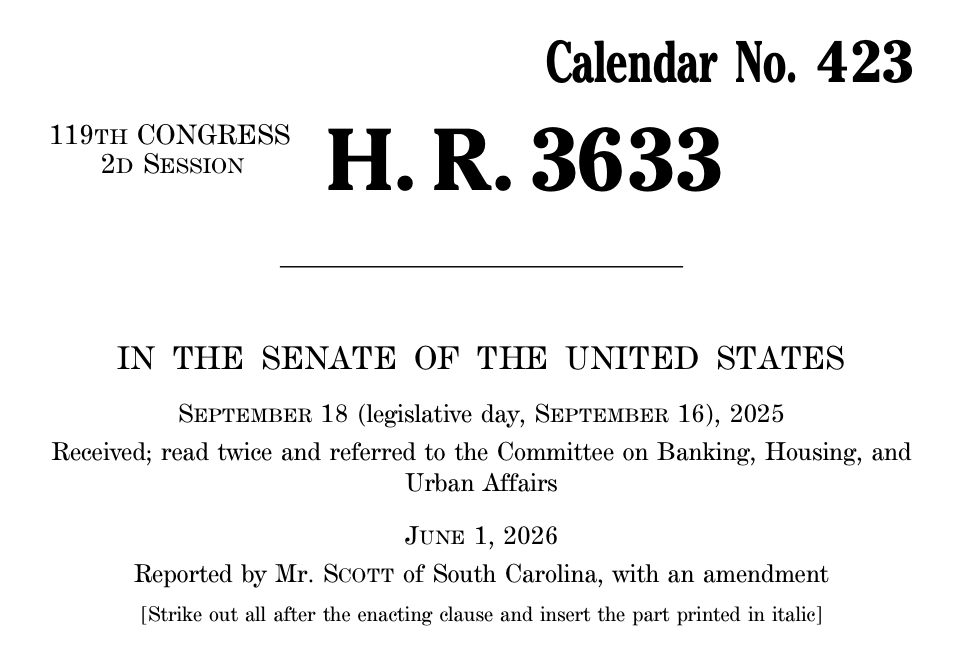
A bill named for clarity has spent fifteen months producing very little of it. On Tuesday afternoon in Washington the Senate will spend a few minutes on a question that sounds trivial and is not: whether to begin debating the Digital Asset Market Clarity Act at all. The vote is on cloture on the motion to proceed to H.R. 3633. It does not pass the bill. It merely asks whether sixty senators are willing to take the thing up. Because of where it falls in the calendar, it is nonetheless one of the most consequential votes American crypto policy will see this decade.
What Clarity has become
The bill’s original ambition was modest in concept and enormous in consequence: draw a permanent jurisdictional line between the Securities and Exchange Commission and the Commodity Futures Trading Commission, define when a digital asset stops behaving like a security and starts behaving like a commodity, and build a registration regime for the exchanges, brokers and dealers that trade them. That is the architecture America has been missing since the first spot market opened, and the absence of which has been litigated case by case for a decade.
What arrives at the Senate floor is a 635-page text. Its sponsors say it carries 126 substantive changes made at the request of Democrats over more than a year of negotiation. Bolted onto the market-structure core are three things that were not in the original design: an ethics title aimed squarely at the sitting president’s family, a stablecoin-yield compromise written for community banks, and a developer-protection title that has quietly shrunk in the drafting.
That accretion is the story. Clarity is no longer a bill about taxonomy. It is a vehicle carrying every unresolved political argument about crypto in America, and each passenger has a veto.
How it got here
The House passed Clarity in July 2025 by 294 votes to 134, with 78 Democrats in favour. It cleared the Senate Banking Committee in May of this year by 15 to 9. On paper this is a bipartisan bill with a bipartisan history.
Then the summer happened. The Senate failed to reach a floor vote before the August recess, which most observers read not as scheduling friction but as thinning Democratic appetite. On the last day before members left town, John Thune, the majority leader, filed the cloture motion anyway. It was life support rather than momentum, but it locked in a date, and the date is now.
Senate Republicans released what they called their final text on Sunday. Chuck Schumer convened his caucus the same evening. As of Monday no Democratic leader had said publicly how the caucus would vote.
The arithmetic
Cloture needs sixty votes. Republicans hold 53 seats, and at least two are expected to vote no on whip estimates, chiefly over the scope of the DeFi exemption. A united conference would need seven Democrats or independents; a realistic one needs nine. Roughly a dozen Democrats have been at the negotiating table for months. Not enough of them have committed in public.
Seven Democratic senators, including Ruben Gallego, who co-authored the ethics compromise now in the text, have said the bill falls short on ethics, consumer protection, illicit finance and market integrity. Elizabeth Warren, who has called it a bill written by the industry for the industry, is organising the opposition.
In principle a senator who wants changes should vote yes on cloture and then fight over amendments on the floor. That is what the motion to proceed is for. In practice Tuesday has become a referendum on whether the current text is close enough to be worth proceeding to, and the holdouts have spent a fortnight saying it is not.
Inside the final draft
On ethics, Republicans say the text reflects substantially all of the Tillis-Gallego proposal. Covered officials, federal judges and their spouses would be barred from issuing or sponsoring a digital asset while in office, with substantial crypto interests divested or placed in blind trust. Crucially for the Democrats who made it a condition, state attorneys general would have an enforcement role alongside the Justice Department. A Senate Republican aide put the administration’s concession at around 80% of what Democrats asked for. Mr Trump, whose family’s crypto ventures are the unnamed subject of the entire title, has signed off.
On stablecoins, Section 404 already prohibits service providers and their affiliates from paying American customers interest or yield solely for holding payment stablecoins, while permitting activity and transaction-based rewards subject to rulemaking, and barring anyone from marketing stablecoins as deposits or as insured products. The new draft adds a circuit breaker on top. If the Treasury secretary determines in writing that substantial deposit flight from community banks is occurring, Treasury would be directed to write rules restricting stablecoin holder rewards. The authority expires eighteen months after enactment. Scott Bessent has publicly committed to using it if community banks are harmed.
The third change went almost unremarked. The Blockchain Regulatory Certainty Act language, which shields non-custodial software developers from money-transmission registration and establishes a civil safe harbour, lost its explicit criminal coverage, including prosecutions under Section 1960. Developers keep the civil protection and surrender the part that mattered most to anyone who has watched a prosecution unfold.
Who is still unhappy
The banks, loudly. The Independent Community Bankers of America and seven other associations wrote to senators arguing that a circuit breaker which trips only after deposit flight has already happened is not a safeguard. They want the rewards language tightened before the fact, and specifically want struck the provisions allowing rewards to vary with how much a customer holds and for how long, which they say turns a loyalty programme into a savings account.
The Democratic holdouts, unresolved. Their objection is not really the text of the ethics title; it is that a sunset in 2029 and a ban on issuance, with personal holdings untouched, does not reach Mr Trump. The ventures that prompted the argument, World Liberty Financial and the token that bears his name, already exist and were already issued. A prohibition on sponsoring a digital asset while in office arrives several billion dollars late, and Democrats who have spent the summer saying so are unlikely to discover on Tuesday afternoon that they were satisfied all along.
A compromise that leaves the banks, the industry and the negotiating bloc all dissatisfied is either the signature of a genuine deal or the outline of a corpse. Tuesday distinguishes between the two.
What each outcome buys
Clearing cloture buys debate, not law. Amendments, a final passage vote, and then the House must take up the Senate substitute. House leaders have cancelled the weeks of 21st and 28th September. The Senate’s tentative calendar has a state work period beginning 5th October, and election day falls on 3rd November. That is roughly fourteen working days to do three things that normally take months. Prediction markets have done the sum: Polymarket prices a bill signed into law in 2026 at about 18%, down from 82% in February, and Galaxy Research has cut its estimate to 30% from 50%. Cloture is necessary and nowhere near sufficient.
Failing cloture buys nothing at all. The bill goes dormant for the remainder of this Congress, the SEC-CFTC boundary stays unlegislated through the midterms, and republican senator Cynthia Lummis’s warning is that the next realistic window may not open until 2030.
The Apollo Crypto View
The interesting question is not whether Clarity passes the cloture vote. It is what the industry is left holding if it does not, and the answer is that American crypto would continue to rent its regulatory regime rather than own it. Paul Atkins’s SEC has been generous with exemptive relief and taxonomy work, and yet all of it can be undone by a successor with a different view and a rulemaking docket. For any business that needs a five-year underwriting horizon, an American exchange, a custody franchise, a tokenised equities venue, the difference between statute and agency discretion is not a legal nicety. It is the discount rate.
For onchain yield specifically, the final draft is more consequential than the headline fight suggests. The Section 404 compromise preserves the stablecoin distribution economy in form while attaching a named official, an undefined trigger and an eighteen-month clock to it. Anyone underwriting float economics on the assumption that usage-based rewards are a settled business model is now pricing a political option they did not write and cannot hedge. The deletion of criminal-law protection for non-custodial developers deserves similar attention, and will get far less.
Our base case remains that the market is correctly sceptical of a signed law in 2026 and insufficiently attentive to what the negotiating has already cost. The text that reaches the president’s desk, whenever it does, will look a great deal more like the banks’ bill than the one the House passed in 2025. However that being said in the near term we expect the SEC and CTFC to remain supportive and actively encourage innovation within the crypto space.

Quinn Papworth
Quinn holds a Bachelor of Business from RMIT, majoring in Finance & Blockchain Enabled Business and has 4 years experience actively investing in crypto markets. Quinn is an analyst at Apollo Crypto and is deeply passionate about producing accessible crypto research content to help educate and onboard users.