
categories
All Categories
- Bitcoin
- Centralised Exchanges
- Crypto
- Crypto Asset Volatility
- Crypto Correlations
- Crypto Governance
- Crypto in the Portfolio
- Crypto Valuations
- DeFi
- ESG
- Ethereum
- Investment Highlight
- Regulation
- Security and Privacy
- Social Media Influence
- Stable Coins
- Traditional Finance and Crypto
- Uncategorized
- UNSDG
- Web 3.0
Authors
All Authors

First Solana ETF With Staking Goes Live
by Quinn Papworth
A few weeks ago in the Apollo Crypto blog we checked in on the state of crypto ETFs taking a look at the flows for the existing BTC and ETH products as well as exploring the possibility of future approvals from the SEC for new crypto tokens, specifically Solana as the next leading candidate.
As of last week we saw the successful launch of Rex Osprey’s Solana ETF with staking. This action not only acts to validate SOL as a major crypto asset but also helps to set a precedent around staking for ETH ETFs and other future crypto ETF products to come to the market.
Rex Osprey’s Launch
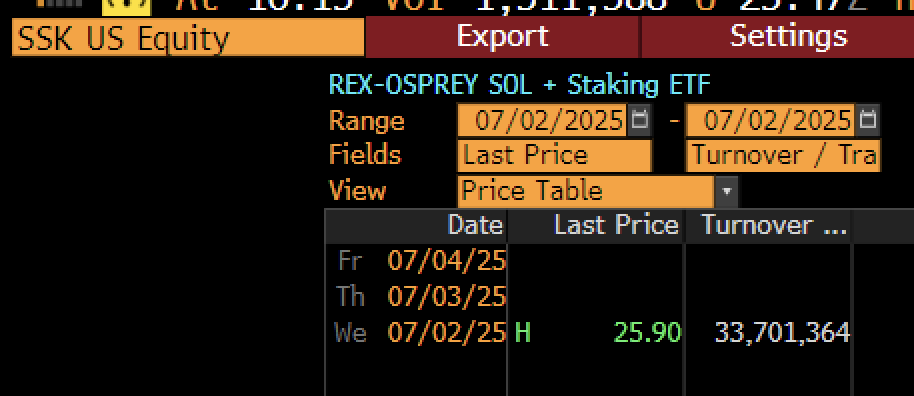
The first US Solana staking ETF went live last Wednesday on the CBOE BZX exchange with Rex Osprey’s SSK product. The fund saw healthy demand immediately with more than US$8 million in volume within the first 20 minutes of its launch. At the end of its first day the fund recorded US$33 million in volume and a net inflow of $US12 million (including the seed amount of 0.6 million) as according to Bloomberg ETF analyst Eric Balchunas. This already places the product in the top 1% of ETF launches globally showing us that there is “definitely demand for these products” as told by the Bloomberg team.
However the price action of SOL failed to make any meaningful move on this news as the net inflows were still relatively small compared to Solana’s total valuation. Could it be that market participants are waiting for the launch of the several other SOL ETFs from the likes of Fidelity, Franklin Templeton, Van Eck, etc. to be approved or does Solana still need to earn the trust of institutional participants?
However, let’s take a moment away from the excitement of SSK’s momentum and look at the nuances of its launch and structure. Why is it exactly that we have Rex Osprey’s product while we are still waiting for SOL ETFs from several other issuers who have filed 19b-4 forms?
As mentioned in our previous insight, Rex Osprey is running a kind of regulatory/legal loophole in order to get these staking ETF products to the market and placing pressure on the SEC to speed up their processes. They achieved this by structuring the ETF as a C-corporation under the Investment Company Act 1940 which sidesteps the typical 19b-4 filing process. This allows the corporation to hold SOL directly and distribute staking rewards to investors without triggering regulatory issues around yield, taxation and custody. However in order to comply with the SEC’s requirements at least 40% of the assets need to be held in other ETPs, often domiciled outside of the US. Because of this 40% of SSK’s holdings are in preexisting Solana ETPs.
As such this structure results in a more expensive fee structure at 1.4% p.a, which is comparatively much more expensive than the fees we have seen from other crypto ETF products. There are already indications that other issuers for Solana ETFs will have fees < 1%. As such this could be a factor stopping allocators from providing capital to Rex Osprey’s offering.
The Implications
The approval of Rex’s product as well as the SEC asking Solana ETF issuers to include staking in their filings continues to bode extremely well for Ethereum ETFs and the prospect of having staking included at some point in the future. If staking is added I continue to expect a significant uptick in ETH ETF inflows, however they should primarily be from investors doing the basis trade arbitrage as the introduction of staking on the Ethereum side boosts the trade’s yield to roughly 7%+. Additionally now that we are already seeing staking available in Rex’s SOL ETF offering it may become the new standard and future crypto ETFs could stand to have staking straight out of the box.
What’s Next
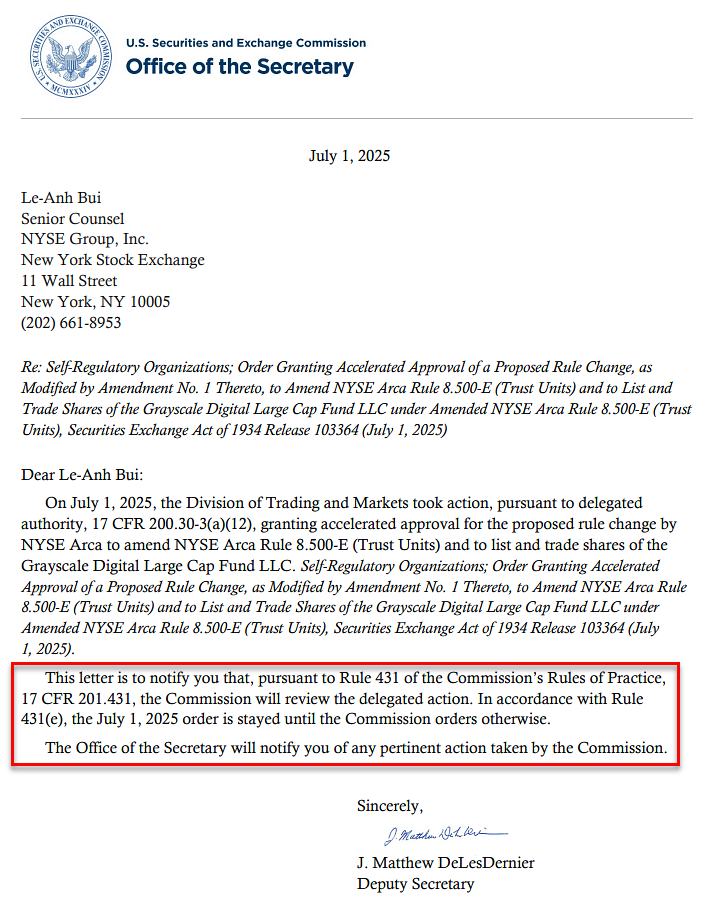
In another positive development, last week we saw Greyscale’s Digital Large Cap Fund (GDLC) was given an approval order from the SEC for their fund to be converted into an ETF. However a stay was put on their ability to actually convert as of right now, Bloomberg ETF analyst Balchunas speculates that this is likely due to the SEC’s intent to establish a unified listing standard for multi crypto asset spot ETFs.
Spot Bitcoin and Ethereum ETFs continue to attract substantial inflows, with BTC ETFs nearing $50 billion in assets under management and ETH ETFs reaching $4.4 billion, signaling robust institutional adoption. A recent BlackRock report noted that 63% of institutional investors surveyed in Q2 2025 increased allocations to crypto ETFs, driven by their familiarity and regulated structure.
The market’s maturation is evident in growing competition and product diversity, exemplified by Rex-Osprey’s Solana + Staking ETF introducing staking yields as well as applications for new products such as buffer ETFs emerging from ARK. With Crypto Week at the White House to begin next week, upcoming policies could further bolster this momentum, painting a bright future for crypto ETFs and the wider industry’s acceptance into traditional finance.


Quinn Papworth
Quinn holds a Bachelor of Business from RMIT, majoring in Finance & Blockchain Enabled Business and has 4 years experience actively investing in crypto markets. Quinn is an analyst at Apollo Crypto and is deeply passionate about producing accessible crypto research content to help educate and onboard users.