
categories
All Categories
- Bitcoin
- Centralised Exchanges
- Crypto
- Crypto Asset Volatility
- Crypto Correlations
- Crypto Governance
- Crypto in the Portfolio
- Crypto Valuations
- DeFi
- ESG
- Ethereum
- Investment Highlight
- Regulation
- Security and Privacy
- Social Media Influence
- Stable Coins
- Traditional Finance and Crypto
- Uncategorized
- UNSDG
- Web 3.0
Authors
All Authors
STRC Marks
by Quinn Papworth
A wobble in Strategy’s preferred shares is a stress test of the corporate-bitcoin model, not its obituary. This week’s overhaul teaches the machine to run in reverse.
This blog covers:
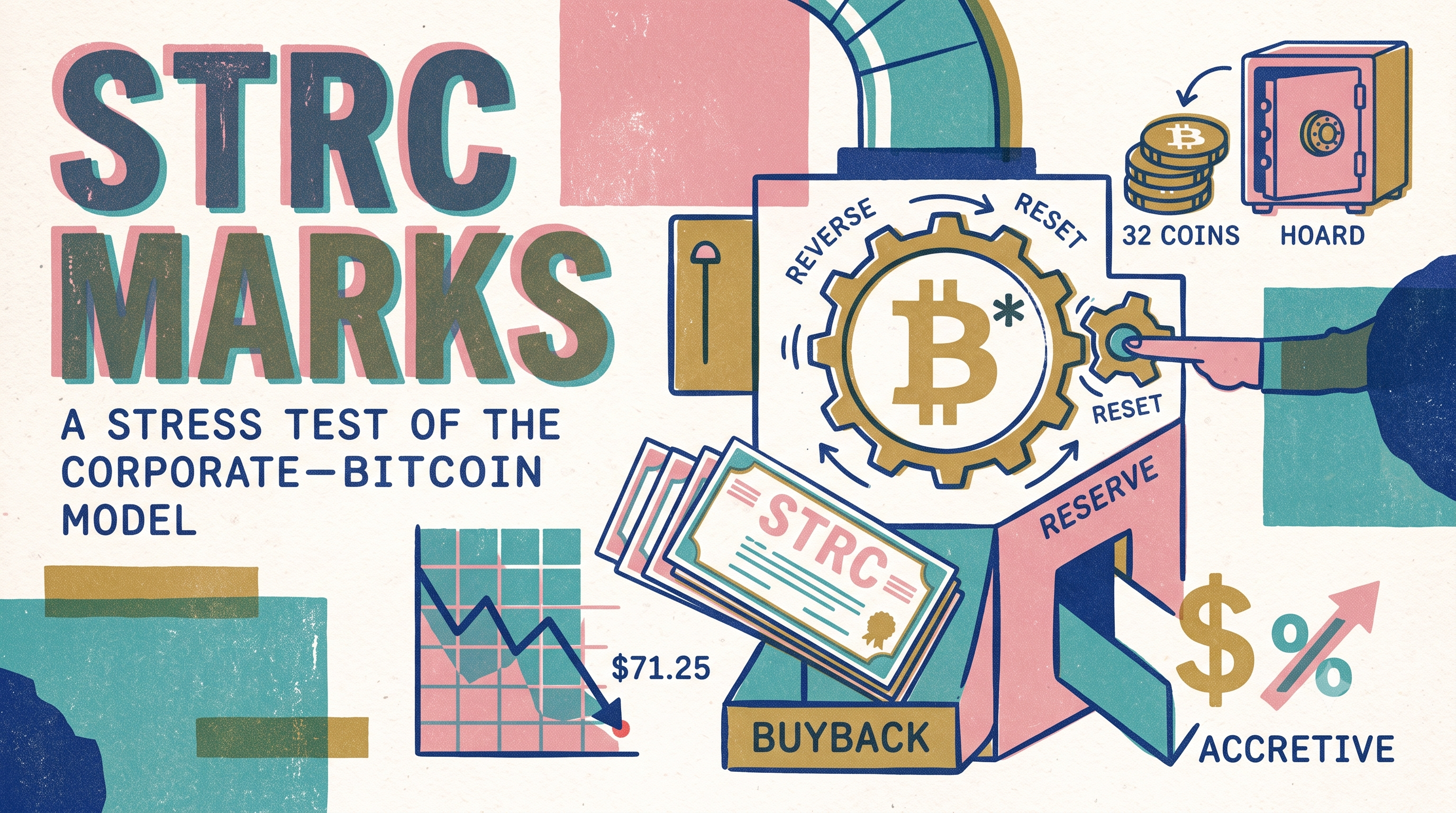
- Why STRC, Strategy’s par-anchored preferred share, slid to a record low $71.25 and what jammed in the process
- The symbolism of Strategy’s first bitcoin sale since 2022: thirty-two coins to cover a dividend
- How the June 29th Digital Credit Capital Framework converts distress into an accretive buyback
- Four durable lessons for the lengthening queue of corporate-bitcoin imitators
- Our read on whether the model bends or breaks
For five years Michael Saylor’s defining promise was a negative one: that Strategy, the software house turned bitcoin leviathan he chairs, would never sell a coin. In late May that promise grew an asterisk. The company parted with thirty-two bitcoin — about $2.5m, or 0.0038% of a hoard now exceeding 847,000 coins — to help service the dividend on a preferred share that had begun to misbehave. The sum was a rounding error. The signal was anything but.
The share is STRC, the Variable Rate Series A Perpetual Stretch Preferred Stock that Strategy floated in 2025 and tuned to sit, placidly, at its $100 face value. The design concept was simple. By adjusting STRC’s monthly dividend, Strategy could nudge the price back toward par, stripping out the volatility that defines everything bitcoin touches and manufacturing, in effect, a high-yield money-market substitute underwritten by the world’s largest crypto balance-sheet. While the share held near $100, the firm could sell more of it through an at-the-market programme and shovel the proceeds into bitcoin. For the better part of a year the machine hummed.
The par that would not hold
Through June this machine seized. STRC had not closed at par since mid-April; by the 26th it had sagged to a record intraday low of $71.25 before limping to a $74.57 close — roughly a quarter below the price it was built to defend. At that level its effective yield had vaulted toward 15%, and the elegant flywheel jammed. Issuing fresh shares below par is dilutive to the structure and faintly humiliating, so Strategy paused issuance, severing the channel that had funded its buying. The common stock, MSTR, behaved like the leveraged bitcoin proxy it has become, shedding roughly 30% in five sessions to $82.31 — its weakest since early 2024 and some 82% adrift of last July’s peak. For the first time the company’s enterprise value slipped beneath the worth of its own bitcoin. The famous premium, briefly, inverted.
The causes were mundane and therefore serious. Bitcoin had retreated below $60,000, down from a $126,000 high last October, dragging sentiment with it. Capital rotated toward artificial-intelligence trades and toward rival treasuries: Strive’s SATA preferred, debt-free and paying a daily dividend. Strategy, having pinned STRC’s coupon at 11.5% for four months rather than chase the price, watched the market call its bluff. The thirty-two-coin sale, disclosed on June 1st, was less a capitulation than a demonstration — proof that the firm would, if pressed, touch the sacred reserve to keep its credit current. Markets fixated on the precedent rather than the reassurance.
Running the machine in reverse
Here the story turns. On June 29th Strategy answered the wobble not with a defiant post but with a balance-sheet: a five-part Digital Credit Capital Framework. It formalised a dollar reserve of roughly $2.55bn — about 17.4 months of cover against the firm’s $1.76bn in annual preferred dividends and interest — and paired it with up to $1.25bn of authorised bitcoin sales, lifting total coverage to some 25.9 months. It nudged STRC’s dividend up to 12% to steady the share. And, most consequentially, it authorised up to $1bn of buybacks of Strategy’s own preferred securities, with STRC first in line, alongside a matching $1bn common-stock repurchase.
The buyback is the clever part. STRC pays $12 a share a year — 12% of its $100 stated amount — regardless of where it trades; repurchase the share at $74 and that obligation simply vanishes, a saving worth roughly 16% on the cash deployed. The subtlety, worth stating plainly, is that nothing obliges Strategy to pay $100 at all: STRC is perpetual equity, not debt, and the stated amount is a dividend base and a liquidation rank, not a sum that ever falls due. That only sharpens the logic. Retiring the claim below par strips out a double-digit dividend yield and books the discount as a gain to common shareholders — and does so well beneath the $101 at which Strategy could call the shares, or the $100 holders could demand only in the narrow event of a “fundamental change.” Distress, in other words, has become an opportunity. The episode’s neat irony is that the same below-par price that broke the issuance engine is precisely what makes the repurchase engine attractive. Strategy’s chief executive, Phong Le, framed the shift as a move “from one-way capital issuance to active capital management”.
Four lessons for the imitators
For the watching corporate world the episode offers four durable lessons. The first is that leverage dressed as equity is still leverage: a perpetual preferred carries no maturity wall, but its dividend is a standing claim that grows heaviest exactly when bitcoin, and thus confidence, is weakest. The second is that “never sell” was always a slogan, not a covenant; even the doctrine’s high priest will trim four-thousandths of a percent of the stack to keep the lights on, and is the wiser for admitting it. The third is that disclosure beats dogma — publishing reserves, coverage ratios and a repurchase mandate has done more for Strategy’s credibility than any pledge ever did. The fourth is the comfort of scale: with 847,363 coins acquired for some $64bn, Strategy could fund years of dividends from sales that would barely scratch the holding. The fortress always had a moat; the only question was whether anyone would lower the drawbridge.
Bend, not break
None of this banishes the bear case. Should bitcoin languish and STRC stay cheap, a richer coupon and recurring coin sales could yet gnaw at the hoard faster than buybacks repair the structure — a slow leak rather than a death spiral, but a leak nonetheless. A prolonged crypto winter would test conviction across the whole treasury cohort, whose premiums have compressed in unison and several of which now trade beneath the value of the bitcoin they hold. Yet the weight of evidence points to a model bending rather than snapping. Strategy’s cash cover has roughly doubled since the spring; and its newest instrument is, in effect, a manual for managing precisely the stress it is under.
The Apollo Crypto View
Strategy’s June scare will be remembered less for the thirty-two coins it sold than for the framework it unveiled in response. The par-anchoring of STRC failed its first serious stress test; the company’s capital management, on this week’s evidence, did not. We read the Digital Credit Capital Framework as a maturation of the corporate-bitcoin thesis rather than a retreat from it — an acknowledgement that holding Bitcoin demands active liability management that looks more like a hedge fund rather than DATs of the past. For allocators the signal is constructive but conditional: the treasury model works when it is engineered to run in both directions and falters when it is built only to issue.

Quinn Papworth
Quinn holds a Bachelor of Business from RMIT, majoring in Finance & Blockchain Enabled Business and has 4 years experience actively investing in crypto markets. Quinn is an analyst at Apollo Crypto and is deeply passionate about producing accessible crypto research content to help educate and onboard users.